
From: DHSC
Assessment date: 25/06/2026
Stage: Live assessment
Result: Green
Service provider: NHS Business Service Authority (BSA)
Service description
The Request a Baby Loss Certificate service was born out of the Pregnancy Loss Review. Currently, there is no formal recognition of baby losses prior to 24 weeks gestation, leaving some bereaved parents struggling to find closure. DHSC commissioned NHSBSA to create the service to fill this gap. It is an online application form which, upon successful completion, results in a physical certificate of loss. The aim is to provide recognition of a life lost and to provide comfort to bereaved parents. It is an optional service, and it is not a legal document.
Service users
This service is for...
Anyone who has a parental relationship to a baby which was lost before 24 weeks of pregnancy who lives in England and their baby loss was in England.
High level user needs this service aims to meet:
- As a user, I need a certificate to commemorate my baby's life after they have passed
- As a user, I need to do this using a service which is easy to find, access and complete
- As a user, I need to know where to find answers to my questions about my certificate
- As a user, I need the option of adding the details that are important to me on the certificate
- As a user, I need to know what to do if there are any problems or difficulties I experience when completing my application
- As a user, I need to be able to complete this form without causing myself or others additional distress
Report contents
- Understand users and their needs
- Solve a whole problem for users
- Provide a joined-up experience across all channels
- Make the service simple to use
- Make sure everyone can use the service
- Have a multidisciplinary team
- Use agile ways of working
- Iterate and improve frequently
- Create a secure service which protects users’ privacy
- Define what success looks like and publish performance data
- Choose the right tools and technology
- Make new source code open
- Use and contribute to open standards, common components and patterns
- Operate a reliable service
1. Understand users and their needs
Decision
The service was rated green for point 1 of the Standard.
Optional advice to help the service team continually improve the service:
- The panel support the team’s plan to continue researching with groups that have had limited representation in the sample so far including other parents and surrogates to ensure all user needs are considered.
- The team are doing a lot to follow an inclusive approach to research, but it would be advisable to conduct in-person as well as remote research to include users who may be excluded from remote only methods.
2. Solve a whole problem for users
Decision
The service was rated green for point 2 of the Standard.
Optional advice to help the service team continually improve the service:
- This service works across two departments NHSBSA and DHSC and is currently working well. As the project moves into Live, continue to ensure the recommendations and responsibilities are clear between the two.
3. Provide a joined-up experience across all channels
Decision
The service was rated green for point 3 of the Standard.
Optional advice to help the service team continually improve the service:
- While the service does well signposting resources such as relevant charities, it could do more to signpost within their own adjacent information pages. For example, the NHS has an information page about ectopic pregnancy. There could be NHS-owned pages that are appropriate to signpost this service that are worth considering.
4. Make the service simple to use
Decision
The service was rated green for point 4 of the Standard.
5. Make sure everyone can use the service
Decision
The service was rated green for point 5 of the Standard.
Optional advice to help the service team continually improve the service:
- There is no provision for Welsh users, and the team has done an initial discovery on this. Continue to make progress so that all devolved nations have an opportunity to use this service or similar.
6. Have a multidisciplinary team
Decision
The service was rated green for point 6 of the Standard.
7. Use agile ways of working
Decision
The service was rated green for point 7 of the Standard.
8. Iterate and improve frequently
Decision
The service was rated green for point 8 of the Standard.
9. Create a secure service which protects users’ privacy
Decision
The service was rated green for point 9 of the Standard.
The team demonstrated a strong and proportionate approach to security and privacy for a service handling sensitive personal information. Evidence provided during assessment gave confidence that both platform-level and service-level controls have been considered and implemented.
Optional advice to help the service team continually improve the service:
- Whilst no significant concerns were identified, the team should continue to mature its monitoring and assurance approach as the service moves into longer-term operational support. In particular, periodic review of privileged access, audit retention, anomalous access monitoring and investigation capabilities will help ensure security controls remain effective as the service evolves and user volumes, features and operating models change.
10. Define what success looks like and publish performance data
Decision
The service was rated green for point 10 of the Standard.
The existing KPIs are useful, but they do not provide a sufficiently strong view of user outcomes, journey friction, service quality or improvement priorities. We should retain operational SLA measures but introduce a more decision-focused KPI framework that demonstrates whether the service is delivering timely and accurate recognition to bereaved parents, where users are encountering difficulties, and where investment or service improvements should be targeted.
Optional advice to help the service team continually improve the service:
- the panel’s strongest recommendation would be to replace the current "completion rate" with separate measures for:
- digital journey conversion
- submitted-to-issued conversion
- resolved application outcome mix
For example:
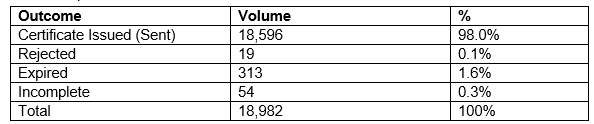
This would provide business owners and service managers with a clearer understanding of what happens to applications once they enter the service, enabling more informed decisions about where users are struggling, and where improvement efforts should be focused.
The team may also wish to consider whether additional measures could add value, such as:
- unhappy path completion rate
- average time from journey start to submission
- application drop-off by journey stage
The panel not necessarily recommending these as formal KPIs; however, it would be useful for team to explore whether they provide actionable insights that support decision-making.
11. Choose the right tools and technology
Decision
The service was rated green for point 11 of the Standard.
The team has consciously chosen technologies that fit the problem rather than over-engineering the solution.
The team demonstrated that its technology choices are aligned to the service's needs and operating model. The architecture makes effective use of managed cloud services and a decoupled design. The use of SQS to separate user-facing journeys from downstream fulfilment processes provides an appropriate buffer against failures or delays in dependent services and supports efficient event-driven processing.
Optional advice to help the service team continually improve the service:
- As the service continues to mature, the team should continue to periodically review technology choices, service dependencies and operational costs to ensure the architecture remains sustainable, cost-effective and aligned to future service needs.
12. Make new source code open
Decision
The service was rated green for point 12 of the Standard.
The greatest value is realised not through publication alone, but through enabling successful reuse.
The team has made positive progress towards open sourcing service code.
Optional advice to help the service team continually improve the service:
- To maximise the value of this work:
- The team should improve discoverability through appropriate tagging, clear repository descriptions and supporting documentation. Documentation should focus not only on how the solution was built, but also on how other teams can adopt, configure and adapt the components within their own services.
- Repositories should be supported by clear README documentation covering architecture, prerequisites, deployment considerations and step-by-step guidance for adoption and adaptation. This will maximise the practical value of open sourcing and increase the likelihood that other teams can successfully reuse the work rather than recreate similar solutions independently.
13. Use and contribute to open standards, common components and patterns
Decision
The service was rated green for point 13 of the Standard.
The team demonstrated appropriate use of open standards, common components and established patterns. Technology decisions prioritised reuse of proven capabilities over bespoke implementation, helping to reduce delivery risk and ongoing support overhead.
Optional advice to help the service team continually improve the service:
- Whilst the service has made effective use of existing common components, the team should seek opportunities to identify reusable capabilities developed as part of the service and package them for wider organisational reuse. For example, print-and-dispatch integration patterns, operational processes and supporting documentation could potentially provide value to other services with similar fulfilment requirements. Doing so would extend the benefits of reuse beyond consumption of common components and contribute reusable patterns back into the wider organisation.
14. Operate a reliable service
Decision
The service was rated green for point 14 of the Standard.
The team demonstrated a pragmatic and proportionate approach to service reliability. Resilience considerations have been built into the architecture through the use of multi-AZ deployment, clearly defined recovery objectives, monitoring and alerting, operational runbooks and a decoupled design that reduces dependency on downstream systems. The approach appears appropriately aligned to the service's criticality and operational needs, avoiding unnecessary complexity whilst maintaining an appropriate level of resilience.
Optional advice to help the service team continually improve the service:
- As the service continues to mature, the team should ensure disaster recovery arrangements are exercised on a regular basis to validate recovery procedures, recovery objectives and operational readiness. For a service of this nature, a six-monthly disaster recovery exercise would provide ongoing assurance that recovery plans remain effective and reflect any changes to the service, team or supporting infrastructure.
Next Steps
Green - Live
This service can now move into a Live phase, subject to getting approval from the GDS spend control team.
The team should repeat the development phases (Discovery, Alpha, Beta and Live) for smaller pieces of work as the service continues running, following spend control processes as necessary.
Leave a comment